


Find Landscape Art Inspiration in Light, Place, and Perspective
When you’re looking for landscape art inspiration, start with a place that makes you feel something—a sunlit field, a wooded path, a mountain view, or a quiet river. Then notice three things artists have used for centuries:
- Light - Is it warm and golden, cool and misty, or bright and dramatic?
- Composition - Where does your eye enter the scene, travel, and rest?
- Human connection - A small figure, cottage, bridge, or road can make a view feel personal and lived in.
That’s part of what we love about landscape art: it doesn’t have to copy nature perfectly to make you feel something. It can turn a real view into a peaceful memory, a story of travel, or a meaningful focal point for your home. At Joyfully Said, our handcrafted pieces are designed to bring that same sense of place into your space, with every canvas and wood sign made to order in Middlebury, Indiana.
Jan Both’s Italian Landscape with a Draughtsman is a beautiful example of the way landscape art can turn an ordinary view into something you want to linger over. Whether you are choosing decor, planning a gift, or selecting a statement piece for your living room, borrow that same idea: begin with what you see, then shape it around what you want people to feel.
So, let’s take a closer look at a few historic ideas—and how you can borrow them when choosing landscape art for your own home.
The Italianate Vision: A 17th-Century Painter and the Art of Observation
In the 1600s, Northern European artists traveling and working in Italy became captivated by its warm light, rolling countryside, and ancient architecture. Instead of sticking strictly to the grey skies, flat pastures, and low horizons of their native Netherlands, pioneering artists like Jan Both, Herman van Swanevelt, and Cornelis van Poelenburch blended northern precision with Mediterranean warmth. They brought that warm, glowing style home with them, helping shape a new way of painting—and experiencing—the landscape. Today, that same devotion to evocative light and a timeless sense of place guides how Joyfully Said designs landscape-inspired wall art for homes across the Contiguous US, including our wonderful design community in Northern Indiana towns like Goshen, Shipshewana, and Elkhart.
How Italianate Painters Transformed 17th-Century Landscape Art
Italianate landscape art became known for glowing light, sweeping views, rocky hillsides, and a feeling of warmth that seemed almost dreamlike. Utrecht-born master Jan Both became a leading figure of this style after spending formative years in Rome during the late 1630s and early 1640s, absorbing the classical compositional balance championed by southern painters and bringing those radiant palettes back to Northern Europe.
In his celebrated work, Italian Landscape with a Draughtsman - Rijksmuseum , Both captures the serene warmth of the Italian countryside at twilight. The painting balances towering, delicate trees on one side with an expansive mountain vista on the other, bathed in golden light that radiates softly across distant ridges and reflective riverbeds. By applying thin, luminous glazes over warm underpaintings, Both simulated the optical reality of late afternoon sun filtering through haze. At Joyfully Said, our handcrafted fine art landscape collection draws on this timeless relationship between natural light, warm earth tones, and quiet scenic storytelling. Each piece is made to order in our Middlebury, Indiana studio, so you can effortlessly introduce that same golden-hour calm into your living spaces.
The Draughtsman's Purpose: Nature, Observation, and Staffage
Look closely and you’ll notice something especially charming: an artist sitting right inside the landscape, quietly sketching what he sees. Seated quietly along a winding dirt road with a sketchbook and quill in hand, the small artist sketches the rolling hills while everyday travelers, pack mules, donkeys, and cattle move gently past him.
Including an artist actively drawing within a scenic vista was quite rare in 17th-century Dutch art. Small figures were common in paintings like this, usually shown working, traveling, or tending animals. It’s a sweet reminder that inspiration often starts by slowing down long enough to notice what’s around us. Research suggests that spending time engaging with art may support relaxation and lower perceived stress. For homeowners seeking the grounding benefits of scenic art in daily life, Joyfully Said offers beautifully curated, ready-to-hang landscape pieces that bring that same restorative atmosphere to your walls.
Monumental Scales and Golden Light: Master Comparisons in Landscape Art
The scale of a landscape painting dramatically alters how we perceive its depth, mood, and presence within a room. Jan Both's masterpiece measures an impressive 188.5 cm by 240.4 cm, making it the largest canvas he ever produced and creating an immersive, panoramic experience for the viewer. When selecting landscape art for your own home, consider how a larger piece can anchor a living room wall, grand foyer, or dining space, much like Both's work anchored the salon of an upscale Dutch residence.
| Artist & Artwork | Dimensions | Primary Lighting Style | Subject & Mood |
|---|---|---|---|
|
Jan Both Italian Landscape with a Draughtsman (c. 1650–1652) |
188.5 × 240.4 cm | Warm, golden-hour evening glow | Italianate mountains, travelers, and an artist sketching outdoors |
|
Peter Paul Rubens A View of Het Steen in the Early Morning (c. 1636) |
131.2 × 229.2 cm | Cool morning sunlight breaking across meadows | Expansive Flemish countryside and manor estate panorama |
|
Meindert Hobbema A Wooded Landscape (1663) |
94.7 × 130.5 cm | Dynamic, dappled light through cloudy skies | Dense forest edge, watermill, rustic cottages, and fishermen |
Comparing Historic Landscape Painters: Light, Scale, and Atmosphere
What makes these historic landscapes so interesting is how differently each artist used light to create a mood. While Both focused on atmospheric southern warmth and golden twilight, Peter Paul Rubens used a sweeping bird’s-eye perspective in Peter Paul Rubens | A View of Het Steen in the Early Morning | NG66 | National Gallery, London . Rubens painted Het Steen as a personal autumn retreat, utilizing horizontal bands of cool morning light and detailed naturalistic elements to establish extraordinary panoramic depth.
In contrast, Dutch master Meindert Hobbema grounded his compositions in intimate, shaded woodland groves. In A Wooded Landscape, 1663 , Hobbema uses dynamic, dappled sunlight breaking through dramatic cloud formations to spotlight textured oak foliage, winding woodland streams, and rustic thatched cottages. And you can borrow the same idea at home: pay attention to whether a piece feels sunny and energizing, soft and peaceful, or rich and moody. Whether you gravitate toward the radiant tranquility of Both’s evening glow or the crisp vitality of Rubens’ morning skies, Joyfully Said offers diverse landscape aesthetics tailored to elevate your interior palette.
Technical Execution: Underdrawings, Paint Layers, and Canvas Paneling
Even centuries ago, beautiful landscape art was built layer by layer, with artists carefully planning depth, light, and texture. Infrared reflectography shows that Jan Both utilized a loose underdrawing in charcoal and dilute wash to map out his majestic tree trunks, rocky outcrops, and receding mountain contours before applying paint.
Both began with deeper, warmer tones and gradually built up the softer light, sky, foliage, and reflective details we notice today. Due to its monumental dimensions, art historians believe Both's expansive landscape was originally commissioned as fixed wall paneling for a prominent town residence in Amsterdam or Utrecht. You can see similar structural integrity and material care in our canvas wall art details, where premium components preserve fine tonal gradations and rich contrasts over time. Our artisan team in Middlebury, Indiana uses archival-quality inks, durable materials, and solid wood frames to ensure your wall art retains its vibrancy and heirloom charm for years to come.
From Northern Realism to Impressionism: The Enduring Influence of Dutch Masters
Those ideas didn’t disappear. Landscape art kept changing as new generations of artists experimented with softer scenery, brighter color, and more expressive brushwork. These evolving styles offer a rich palette of design options for homeowners today, bridging the soft haze of British pastoral scenery, the refined elegance of French country estates, and the vibrant, emotional energy of Post-Impressionist fields.
British and French Interpretations: Mountain Scenery and Pastoral Landscapes
In 18th-century Britain, Thomas Gainsborough combined Dutch woodland atmosphere with poetic mountain scenery, helping pioneer the English Romantic aesthetic. In Mountain Landscape with Bridge, c. 1783/1784 , measuring 113 by 133.4 cm, Gainsborough applied thin, fluid glazes over a dark pinkish-brown ground to produce a soft, atmospheric haze across rolling hills, rocky chasms, and rustic livestock bridges.
In France, artists such as François Boucher took pastoral scenery in a more decorative direction, filling landscapes with graceful trees, winding water, and romantic countryside details. In François Boucher | Landscape with a Watermill | NG6374 | National Gallery, London (1755), Boucher framed his idyllic rural composition with graceful, arching trees reminiscent of Claude Lorrain, balancing silvery-green foliage, crystalline waterways, and charming rustic architecture. These romantic compositions inspire our curated fine art vintage wall art collection, which allows homeowners in Northern Indiana and across the nation to bring the timeless elegance of classic European pastoral landscapes into their modern living rooms and dining areas.
Emotional Resonance and Expressive Surface: Post-Impressionist Vision
By the late 1800s, landscape art was becoming more personal and expressive. Artists were no longer simply painting what they saw—they were painting how a place felt. In Vincent van Gogh | Landscape with Ploughman | L1333 | National Gallery, London , painted in 1889 during his stay at Saint-Rémy-de-Provence, Vincent van Gogh transformed a simple rural view into an moving reflection on human labor, seasonal renewal, and perseverance.
Measuring 49 by 62 cm, the canvas features heavily loaded impasto brushstrokes, directional rhythms, and radiant complementary colors circling the rising sun over plowed fields. For homeowners drawn to this expressive energy and textural depth, Joyfully Said offers handcrafted landscape art prints that capture similar warmth, movement, and visual character. You can bring that same warmth and movement into your home with a handcrafted piece chosen specifically for the feeling you want your room to have.
Curating and Styling Historic Landscape Aesthetics in Contemporary Homes
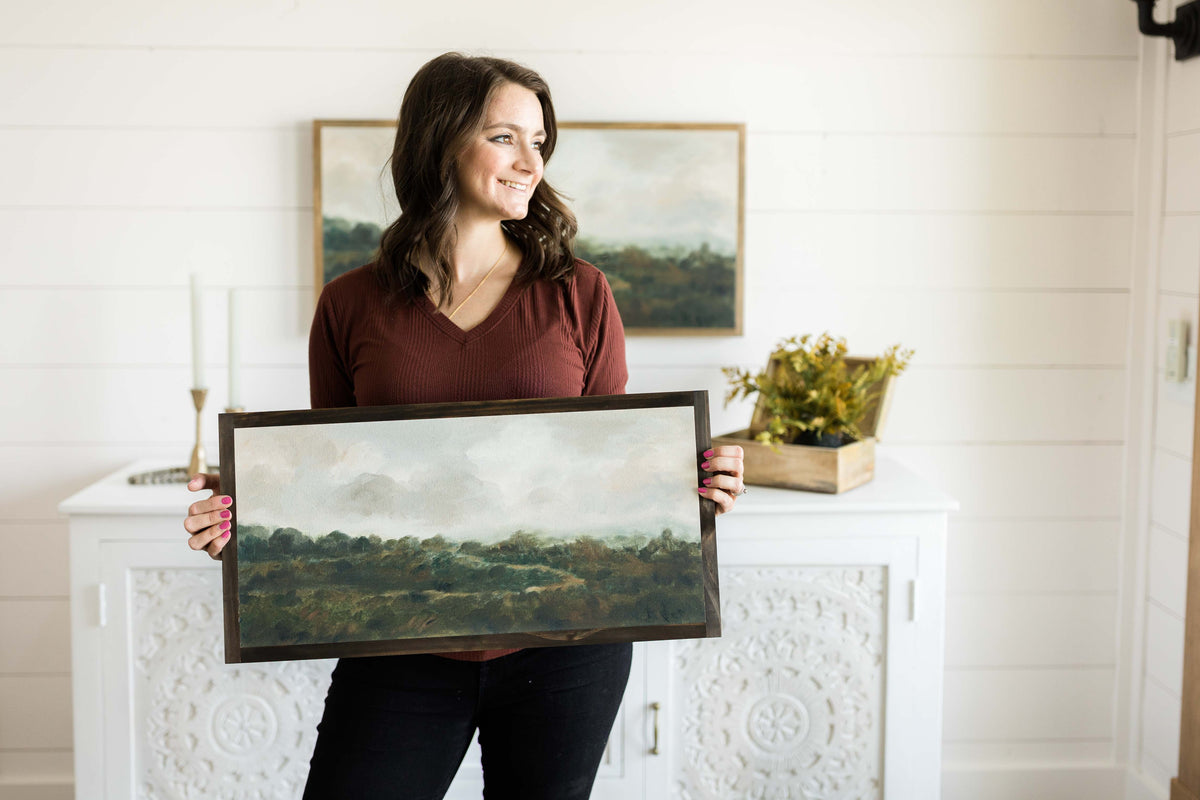
Shop this look: Wandering Trails | Anee Shah
One of our favorite things about landscape art is how easily it settles into a modern home. Whether you are styling a cozy reading nook in Elkhart, refreshing an entryway in Goshen, or curating a formal dining space in South Bend, the right landscape piece establishes an inviting focal point that balances vintage soul with modern simplicity.
Bringing Historic Landscape Art into Modern Living Spaces
Not sure where to start? Try pairing landscape art with linen, warm woods, woven textures, or aged brass. A large scenic canvas makes an impressive statement above a living room sofa, fireplace mantel, or bedroom headboard, anchoring the entire room with soothing earth tones.
For balanced proportions and visually harmonious layouts, explore our 5 tips for selecting artwork for your home and consult our practical guide to art placement to hang your wall decor at ideal eye level. We also love mixing landscapes with florals, abstracts, or meaningful word art. The pieces don’t have to match perfectly—they just need something that ties them together. Our experienced design team in Middlebury, Indiana is always available to help you select harmonious scales and color combinations tailored specifically to your home’s architecture.
How Framing Changes the Feel of Landscape Art
Part of the beauty of landscape art is its timelessness. A peaceful countryside or sweeping mountain scene can feel just as at home in a modern room as it did generations ago. For example, the historic 1839 sale of Meindert Hobbema’s A Wooded Landscape famously provided funds to construct 80 solid stone cottages for tenant families in Ireland, demonstrating the lasting social and architectural legacy of masterwork collections.
Framing plays an essential role in preserving this visual heritage and integrating it into modern spaces. Choosing premium framed canvas art with handcrafted solid wood frames gives scenic prints a refined, heirloom presence that complements transitional, traditional, and modern farmhouse interiors alike. At Joyfully Said, every framed sign and canvas print is handcrafted to order in our Northern Indiana workshop, giving you professional framing quality and artisan craftsmanship ready to display in your home.
Frequently Asked Questions About Landscape Art Inspiration
What makes Italianate landscape painting unique compared to native Dutch styles?
Italianate landscape painting is distinguished by its golden Mediterranean light, elevated viewpoints, and warm color palettes inspired by the Roman countryside. While traditional Dutch landscapes focused on low horizons, windmills, and overcast skies, Italianate works emphasized sunlit hills, classical ruins, and pastoral harmony. This warm, sunlit aesthetic is especially popular among homeowners in the Contiguous US who want to bring a sense of travel and warmth into their spaces.
Why is the inclusion of a draughtsman so significant in Italianate landscape painting?
The draughtsman is a rare self-referential motif that highlights the importance of outdoor sketching and direct observation. It documents the artist’s creative journey on the Grand Tour and invites the viewer to reflect on how nature is translated onto canvas. For modern art lovers, this motif is a reminder that great landscape art begins with careful observation—something Joyfully Said honors by crafting pieces that capture the essence of a scene without requiring you to pick up a brush.
How can you style classic landscape aesthetics in a modern home in 2026?
For a modern look, try one larger landscape in warm, earthy tones and let it be the room’s quiet focal point. For homes in Northern Indiana, consider pairing a golden-hour landscape with natural wood accents and soft textiles to create a cohesive, inviting look. Our team in Middlebury, Indiana can help you select the perfect piece for your space.
Conclusion
The best landscape art does more than fill a wall—it brings a feeling, a memory, or a little piece of the outdoors into your everyday life. From the radiant golden glow of Jan Both’s Italianate vistas to the atmospheric woodlands of Hobbema, historic landscape traditions show us how light, depth, and storytelling can transform a room.
Still deciding which landscape art feels right for your home? We’d love to help you find a piece that works beautifully with your space, style, and the feeling you want to create. Contact the Joyfully Said team and let’s find something you’ll love seeing on your walls for years to come.
Leave a comment